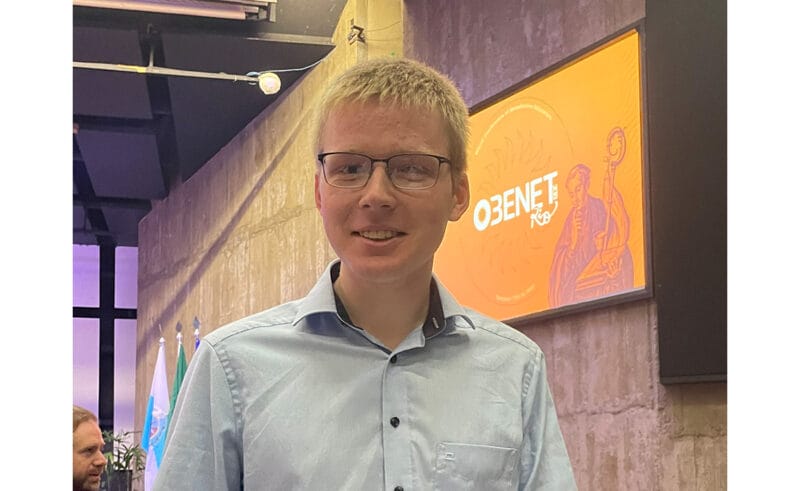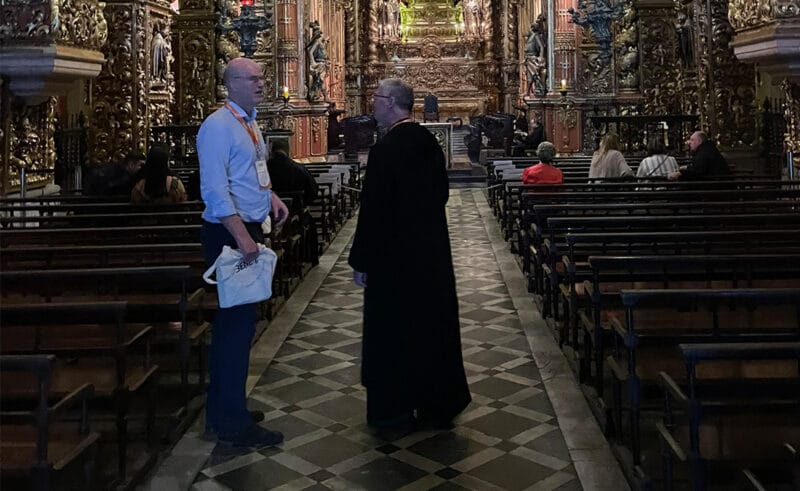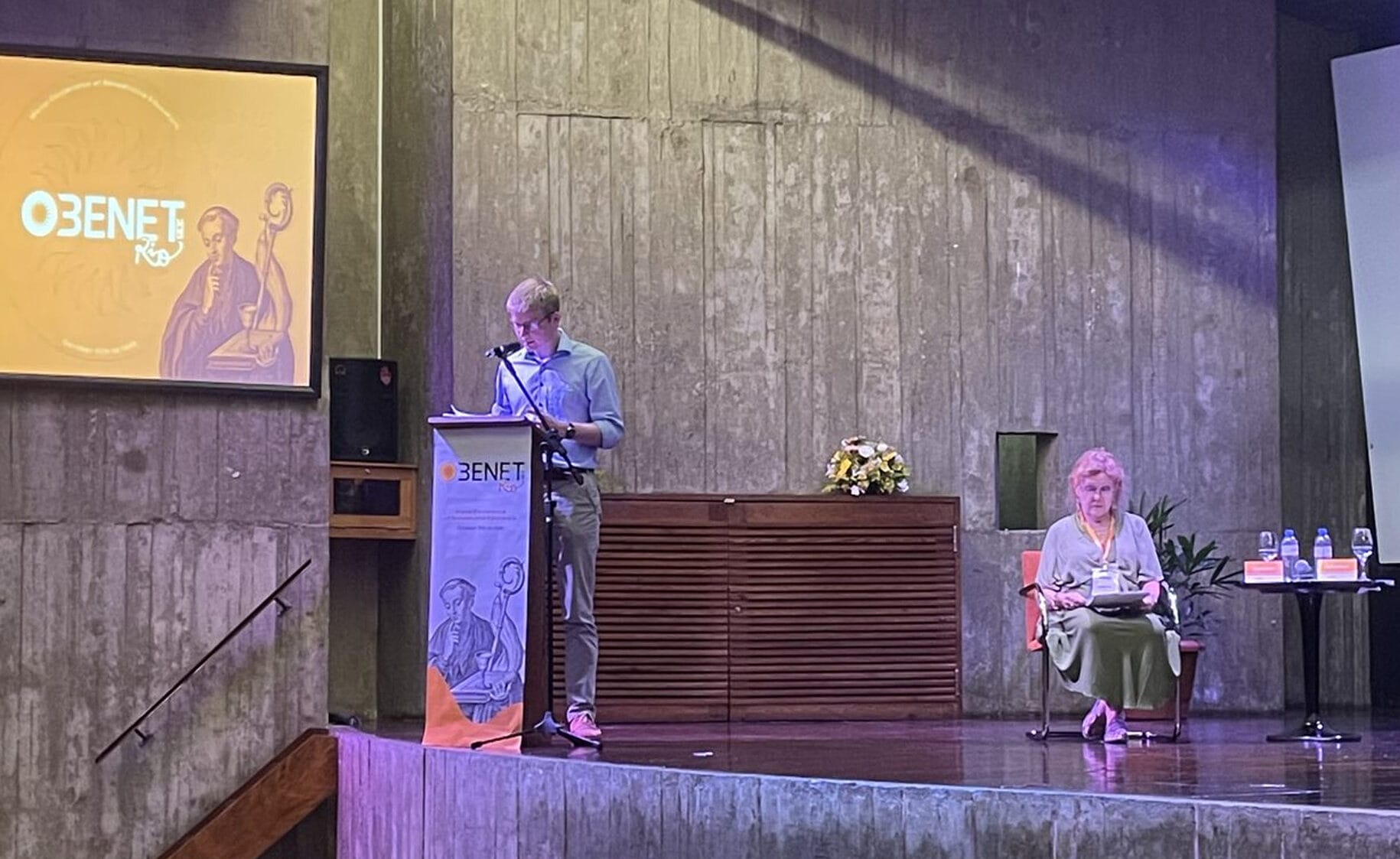
BNEet, the international conference of Benedictine Educators is organised by the ICBE (International Commission on Benedictine Education) and takes place every three years. This year the conference took place in the Monastery of São Bento in Rio de Janeiro, Brazil.
The Head, Andrew Hobbs, and Chair of Governors, John Ludlow (C82), both attended the conference and were accompanied by Owain Daley (R21), one of four speakers.
Please read below Owain’s speech in full, which reflects how much he believes his Benedictine education at Downside has changed, and shaped, his life immeasurably.
Owain Daley’s speech at BENET Conference October 2023
“Community was fundamental during my time at Downside. The school was a community and I experienced this in many different ways. Downside was originally a monastic school, while the monks were still at the school it very much felt like part of an extended monastic community. This was especially due to the shared Sunday Mass with the monks, where students had an integral role in the liturgy. The school and the monastery shared one patron (St. Gregory the Great) and for me at least, his Feast day was always a particular point of closeness between the life of the monks and of the school. When I started at Downside very few monks still worked in the school, but they were still central. The life of the monastery next door was impossible not to notice, with the bell tolling for offices and Mass. Joint masses between the monks and school were always, at least for me, the pinnacle of the unity of these two parts of the same community. Even with little practical involvement of the monks, the Sunday mass continued to hold us together, and allow the monk’s life to flow into the school. Toward the end of my time at the Downside, the monks decided to move to a new home. The practical manifestations of this, in terms of the school’s day to day running, were small; but the change was stark. The monk’s absence is particularly noticeable at mass. However, the school Mass remains a key moment in the week. It still serves, in my opinion, as the climax of a community life, which is built every day in so many different ways. The time we spend in Sunday mass together is only a fraction of the time spent together as a school community. But I think it is where the many different elements of community building come together in one act of turning towards the Lord. Downside is a boarding school, and this was key to my experience of community. Students are arranged into ‘houses’. In practical terms your House is the physical location where you sleep, but it is much more than this. Your house is your community, you sit with your house at mass, compete for them in competitions, and engage in many recreational activities together. Each house contains a cross section of different year groups and is led by a ‘Housemaster’, who has responsibility for the pastoral and academic care of the pupils in their house. The Housemaster gets to know the children in his care well, he can tailor support, encouragement and correction to their individual needs. A good housemaster ‘knows his own sheep and his own know him’. The mix of year groups in a house is key to its function as a community. Pupils of different ages can interact, friendships can be made which are not merely confined to your academic year. Also, in the way of a good community, older members can set an example for younger members, and help them out, not becoming too distant or caught up in their own concerns. In fact, Downside has a specific system for this which I will come to later. Each house has its own characteristic and I very much felt I belonged in my house. Houses break the larger school community into human units. Having several smaller communities allows the school to function better as one large one. At Downside, in the tradition of the Manquehue Apostolic Movement, Pupils are invited to join a Lectio Divina group. (By Lectio Divina we mean the prayerful reading of the scriptures in order to encounter Christ.) In these groups students join together under the leadership of an older student to encounter Christ through his word. During the group meeting there is a time where to share with each other our personal reflections on encountering Christ in the scriptures. Lectio groups become a close community, a place of trust. Students can walk together not just in their academic journeys, not just in their social times, or meal times, but in their journeys of faith. For me being in a Lectio group was fundamental to my experience of Downside. It allowed me to see that it was Christ himself who held our community together and gave it meaning. Though not all the students got involved, I think the community life fostered in Lectio groups did flow out into the life of the school in a similar way to how the Monk’s life had done. My understanding of community grew as I went through the school, but even within my first few days there I was hit by the impact of belonging to a community. I have played the bagpipes since I was nine years old. Downside had a pipe band and when I had just joined I was taken along to a rehearsal by one of my teachers. I was immediately welcomed. Again, there were pupils from a range of different year groups who were friendly and showed interest in me. Thanks to the community of the pipe band, merely a week and a bit into my time at the school there were people I felt I knew who smiled, said hello and checked up on me round the school. Community was also very present in sport. I became a core member of the cross-country running squad. We actually competed very little, but ran frequently together and simply enjoyed getting outside and being together. Here again, there was a mix of different years in the group, but we all felt very able to chat, pull each other’s leg and encourage one another. The teachers, though obviously in a position of authority, were also very much part of the group. They did everything we did with us, joked and chatted with each of us and knew us well. I did not start running really other than to avoid other sports, but it was so enjoyable doing it as part of a group that it became one of the highlights of my week. I improved much more as a runner than I could have done alone. What I learned and developed in the community started to manifest whilst I was alone (I’m now a keen runner with or without a group). Actually, this was also the case with learning to pray through Lectio groups. Something I learned initially in a community became something integral to me as an individual and lectio now forms a key part of my life both when I am with other people and when I am alone. One final reflection on my experience of community at Downside is that it allows those who don’t believe in Christ, or who are unsure in their faith to enter even so, into the life of a Benedictine school, and be touched by Christ. This is something which I will touch on a bit more later when considering what a Benedictine school can offer to someone with no background of faith.
The lasting influence of their Benedictine education
“The more I look back on my time at school, and the time since, the more I am struck by what a profound impact it has had on me as a person. There’s not much, or any of who I am that hasn’t been shaped by Benedictine education. That’s not to say that what I received before going to Downside (in large part from my family) was unimportant and simply got overwritten. But Everything I had before I went to Downside was taken up in my education there and allowed to mature and flourish, and have much added on top. Music had been a passion of mine long before I went to Downside, but through the opportunities available, and most of all, the generosity of my teachers I was able to deepen my love and understanding of music. The same was true with my academic interests and desire to learn. These examples illustrate how Benedictine education shaped me, not necessarily by giving me anything new, but by allowing me to grow as an individual. However, I think the most fundamental way in which Benedictine education shaped me is by its impact on my faith. I have always been Catholic, with a strong sense that that was the right thing. But at the point I joined Downside my faith was only really one of practices. The most important thing I was taught at Downside, was how to pray, specifically through Lectio Divina. This is the thing I have learnt in my life which has had the most effect on who I am, and it overarches all the individual elements of my education, reaching into every aspect of my life. This is because true Lectio Divina means meeting Jesus Christ. Christ is the most important person you can meet in your life, and for me I met him through what I received at Downside. Lectio gave meaning to my whole school life. It allowed me to approach it as a Christian, viewing it through Christ’s eyes, not my own. Downside had a prefect system, where older students took responsibility for leadership. In my final year I became the head of the junior house. This involved taking responsibility for the youngest boys in the school, supervising them at break times and study times, helping out with assemblies, getting students into bed on time. Most importantly though, the role was to be someone who was present and had time for them, to encourage them, guide them, be someone friendly and approachable. For me this role was a massive privilege and a real joy. Downside taught that to be a leader was to be a servant. I fell in love with the opportunity to be a servant to the younger boys and had the opportunity to experience the joy of being a shepherd to them. For me, this role was intrinsically linked to my faith; I wanted to be a witness to Christ simply by my presence and ordinary interactions. I always prayed for the boys and really grew to feel invested in them as people. The role helped me to appreciate God’s goodness, seeing his wonders in all those I worked with, realising the worth that each boy had as an individual, regardless of their behaviour or academic performance and to have the opportunity to give of myself to them regardless. It gave me the opportunity to grow in my understanding of people, my patience, my skills of authority and importantly it gave me a love of service. The experiences of prayer and of servant leadership I had at Downside allow me to know that, however I may behave, at the end of the day, my ultimate desire, my true happiness, is to be Christ’s servant. And it is these experiences which have allowed me to persevere in the path of Growing as a Christian. Moving on from Downside and starting to study at university, my faith has continued to grow. It has become my one firm anchor throughout all the different changes of my life and it has given my life a distinct shape. I currently live in a community with other catholic students and am deeply involved in the work of my university Catholic Chaplaincy. I have also been back to Downside to work in the chaplaincy there. Faith has brought me to some incredible friendships which really are life giving. In all these different ways, and many others, Jesus has given my life its shape through faith. This faith, which is responsible for me being the person I am now, was something I received in a Benedictine school. It is in this way that Benedictine education has shaped my life immeasurably.
What do we offer as Benedictine educators?
“Whilst for me faith is inseparable from my Benedictine experience, clearly many students in our school’s are not baptised or practising Catholics. I think for a student to receive as fully as possible from a Benedictine education, they must be alive to the faith of the school. But, in my experience many students with no faith were still shaped massively as people at school, and left with many fond memories. Even if they didn’t really believe in the Benedictine ethos, they still had many good experiences because of it. I think a major reason for this is because the school was a community which fostered friendships. If going to school means spending time with all of your friends, you’re not going to end up having too bad a time. Further than this, I think having a school which focuses on community and friendship is actually something which is increasingly more unique. It seems for me, living in the UK, that young people are increasingly more lonely. Community seems to be giving way to increasing individualism. The focus is on measurable achievement, top marks, prestigious university entrances and so on. There’s so much focus on personal success, ‘who I am’ and ‘making myself happy’. In a community, who you are is undoubtedly important (and I will come back to this in a moment), but only so much as it contributes to what the community is. ‘Who I am’ is expressed most fully in forming part of something greater. In a great painting, the individual hues are beautiful in themselves, but this is nothing compared to what is created when they are brought together, each hue adding what only that hue can bring. Taking the focus off ‘who I am’ and ‘what makes me happy’ is also intrinsic to true friendships, and for this reason I think true friendships are increasingly lacking in society. We don’t use a friend as a means for happiness or self affirmation; we serve a friend because we love them, we seek their help and advice because we trust them, a true friendship can only be about the ‘us’. That may have seemed a bit long-winded, but I think that’s what Benedictine schools can provide, counter to much of the world around us. In doing so we can provide something which, whether they realise it or not, many people deeply need and hunger for. I think this experience is also one of the best ways we can hope to bring students of no faith to Christ. One final thing which is very important to provide and is vital for the experience of those without faith is ‘Concern for the Individual’. I think this is a hallmark we can claim especially as Benedictines. This is the first thing I thought of when asked what a Benedictine school could provide to those of no faith. It strikes me that this is again something which can make us as Benedictine schools quite unique. Downside was a community and each member was part of a whole. This didn’t detract from each student’s uniqueness, it enhanced it. Every member of the community was valued for the unique contributions they had to make. The culture of pastoral care in the school worked with students as individuals, treating them each as a separate person with unique strengths and weaknesses. No one was simply a troublemaker who we would be better just letting fall by the wayside. The focus was not so much discipline as formation, even perhaps transformation. There wasn’t an attempt to press students into a mould, they were taken as they were. The school came to the student where they were and took things forward from there. The school wasn’t about efficiency, working with individuals is not efficient, it takes time, generosity and love. Being on the receiving end of this time generosity and love has quite an impact, it really helps students to flourish, to grow into the truest, happiest versions of themselves. This impact is felt regardless of your position of faith. I think it is key for Benedictine educators to be those shepherds who leave the ninety-nine sheep in search of the one, to be people with a real passion for the individual beauty of each human person and helping them grow in this beauty.
Parting words for the future
“My closing message is first one of thanks. Thank you for listening! . Thank you for what you provide. I have to thank especially my own Head-Master Andrew Hobbs, who puts into practice what I have talked about today, with the help of many others who share his passion, commitment and enthusiasm. I’d also like to encourage you. As Benedictine educators God has given you genuine opportunities to transform people’s lives and to be, ‘bright lights’ in the world. Hold Christ himself at the forefront of everything you do and know that in doing this you offer to each student at your school true Joy, hope, strength and wisdom. What you do has meaning and purpose because God has called you to do it. Foster a community of friendship, be part of that community yourself. Invest in each student as an individual, loving and caring for them as part of a community. Maybe what I’ve said is idealistic. I understand that it’s one thing saying how a school should be run, but a very different thing to run one! You have to make the hard decisions, balancing the ideals of Benedictine education with the often inescapable demands of the world. This is where I have to hand it over to you as people with much more wisdom and experience than me. But, what I have said today is a true experience. It is not something I created. It was provided to me. I just had to engage with it. What I have spoken of today is of immense worth even if it seems only a fraction of your students experience what I have described. You are sowing the seeds of the kingdom. The mustard seed may seem small, it may seem of little value, but with trusting patience you will see the birds of the air nesting in the tree you have grown. God has set you alight as a lamp for many, don’t hide under a tub!”